According to a popular movie, there are perks to being a wallflower. I never found any. If anything, social awkwardness has a talent for making sure you miss out on the cool stuff, not the other way around.
One particular start of a school year stuck with me. I'd had zero contact with my classmates for two months over summer, and I came back excited to see their faces again. That excitement didn't last long. My three best mates had spent the entire break playing some video game, and it was apparently all they talked about now. I had no idea what any of it meant and, having committed a sin of summer negligence, I'd been exiled from my own nerd group.
I was already months late to whatever this was, so I did the only reasonable thing a fifteen-year-old could do: I lied to my mother. Told her our teacher wanted us to get some "educational software" for school. It remains the best social engineering job of my life.
I ordered the game from some online shop that still offered cash on delivery. This was before CD-keys, before instant downloads. You ordered something, and then you waited — three to five business days, which at that age might as well be a year. I checked the tracking number every day like it was going to say something new. Then, finally: delivered.
I told my mates I'd be online that evening. Then I ran home, ripped the wrapping off in one violent move and finally got my hands on the game I'd spent the last few days obsessing about.
The "educational software" was called Guild Wars.

Source: Guild Wars Wiki
It launched in April 2005, developed by ArenaNet and published by NCSoft. Calling it successful would be underselling it. Within its first year it had already sold over a million copies, and before long it had become one of the defining online games of its generation.
Part of the appeal was the price—or rather, the lack of another one.
Back then, buying an online game wasn't the expensive part. Keeping it alive was. Most Massive Multiplayer Online Role-Playing Games (MMORPGs) charged a monthly subscription on top of the box price. You'd pay for the privilege of paying again. Guild Wars looked at that idea and simply went, "Nah."
ArenaNet even printed "No Subscription Fee" on the box. In 2005, that was less of a slogan and more of a declaration of war.
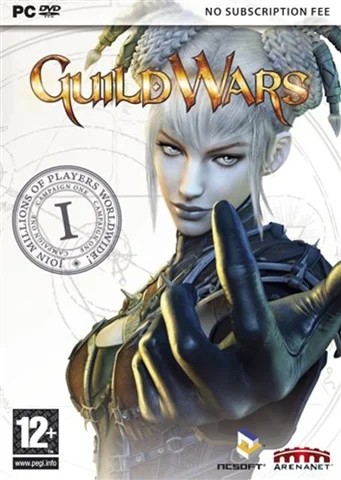
Source: CeX
So what actually is an MMORPG?
Imagine a fantasy novel where instead of following one chosen hero, everyone gets to be the chosen hero at the same time. Thousands of people log into the same world, kill monsters, collect increasingly shinier trousers, and convince themselves that one more run is a reasonable idea.
Guild Wars split that experience into two very different games wearing the same skin.
The first was PvE — Player versus Environment. You worked through campaigns, fought whatever game designers had cooked up for you, and unlocked new areas as you went. You could bring friends, or you could bring henchmen — computer-controlled allies who weren't artificial intelligence in any modern sense. They couldn't write your dissertation or talk your grandmother into buying crypto. Their job was considerably simpler: don't stand in the fire and occasionally heal you. Even that wasn't always guaranteed.
The second was PvP — Player versus Player. Instead of fighting monsters, you fought people, which, as history keeps demonstrating, is what humans really wanted all along.
The entry point was the Random Arena: four of you, four strangers on the other side, thrown together by an algorithm that didn't care who you actually wanted to fight with. No commitment, no small talk, just combat with people whose names you'd forget in ten minutes. It was chaotic, fun, sometimes terrible — but it was the perfect introduction before moving on to the main course: GvG.
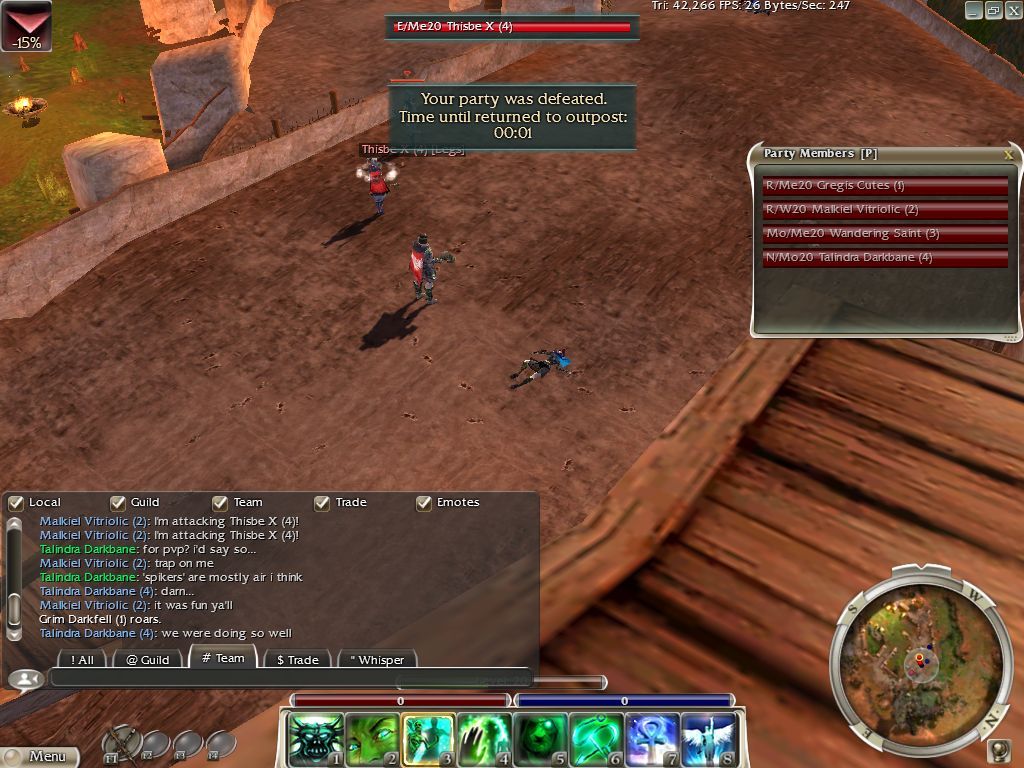
4v4 combat in Guild Wars
Source: Black Falcon Games
Guild versus Guild was the format the entire Guild Wars community existed to feed into.
The rules themselves were simple enough. Two teams of eight players entered the battlefield, each defending a base where their Guild Lord — an NPC and the most important man in the kingdom despite doing absolutely nothing for most of the match — patiently waited for events to unfold.
The objective was straightforward: kill the enemy Guild Lord before they killed yours. Simple in theory. Considerably less simple when eight other people were actively trying to prevent it.
The real chess started before the match even began — with builds.
Each player could choose from six professions: Warrior, Ranger, Monk, Necromancer, Mesmer, and Elementalist. Later expansions increased that number to ten. On top of that, every character could also select a secondary profession. You could play a Monk/Elementalist if healing your teammates wasn't enough and you occasionally felt the urge to strike someone with a lightning bolt.
More importantly, every player could bring only eight skills into battle. Eight players per team. Eight skills each. Suddenly a single match became sixty-four carefully selected abilities interacting with one another. Entire tactics were built around those choices. One small change could force a guild to rethink everything.
But before all this, to even think of showing up to a GvG match, you needed a guild — an actual structure inside the game, with its own bank, its own cape, and its own rank on the ladder. Starting one cost gold. Running one properly cost a lot more. Capes had to be commissioned, halls had to be claimed and upgraded, and none of it appeared for free. Capitalism in its purest form reached as far as the fantasy world of Tyria.
Then came another challenge: finding seven (at least) other people who could play at your level and, harder still, would actually show up. Leading a guild wasn't a title, it was unpaid middle management. You recruited. You benched people. You dealt with egos considerably larger than the imaginary castles everyone was fighting over.
That's where the rivalries formed. That's where reputations were built. Some players treated it as a hobby. Others treated it as a competitive discipline years before esports became a mainstream career path.
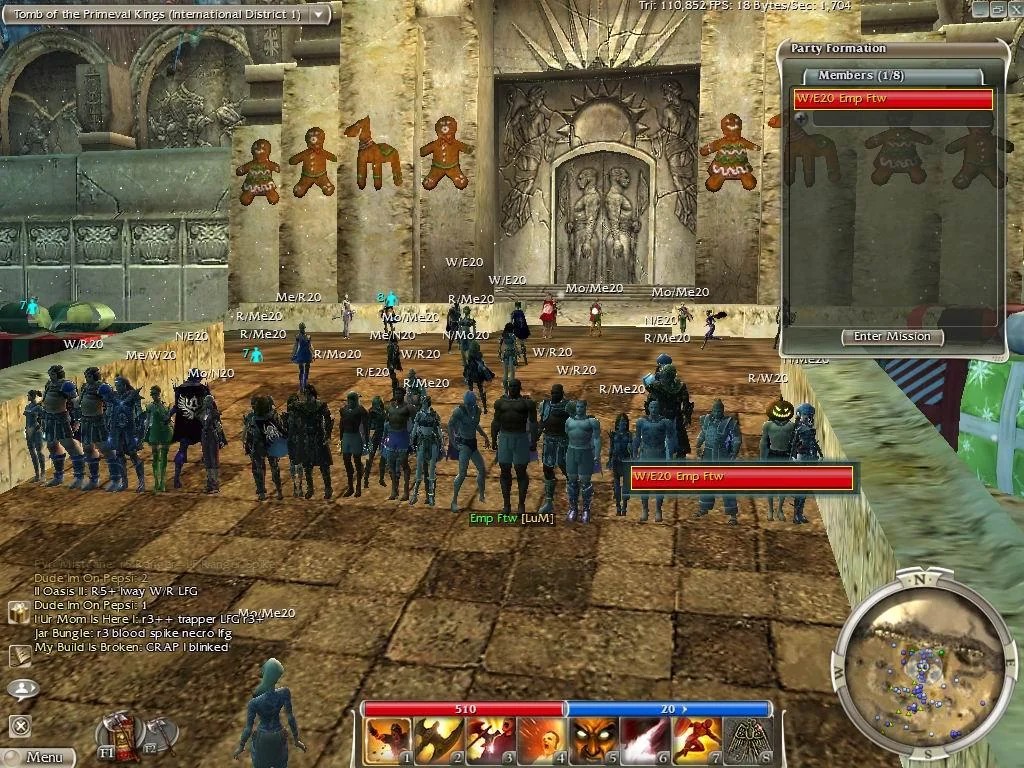
Members of LuM in-game
Source: Eero Lahtinen
To understand Guild Wars at that level, I knew I needed to speak to people who were there when the game was at its peak. The game had its own ranking system and competitive ladder, which served as an access point to international LAN tournaments where the best players in the world competed for the title of World Champion.
Esports in the mid-2000s looked very different from today. There were no million-dollar prize pools, no professional teams with marketing departments, and no players becoming global celebrities with their own agencies. Most of these people were simply extremely good at a game that happened to have a competitive scene.
Finding them twenty years later was not exactly straightforward. I had almost no information beyond a few guild names and player nicknames. I spent weeks digging through the Wayback Machine, reading archived forum posts and forgotten websites, trying to reconstruct a small piece of internet history. At some point, the entire process started feeling less like research and more like a low-budget Netflix documentary about a guy obsessively trying to find people who were once famous in a very specific corner of the internet. With help from the Reddit community, I eventually managed to get in touch with two players who were not only part of that era but were among the best in the world at the time.
The first was Lee Kyung Pyo "Legend of Danjang", a South Korean player, co-owner and vice leader of The Last Pride [EvIL] — one of the most dominant guilds of its era.
The second was Eero Lahtinen, a Finnish player who competed for Lamers Ultimate Majority [LuM] and later Irresistible Blokes [iB]. Both guilds reached the highest level of international competition, with LuM finishing in the semi-finals and iB reaching the quarter-finals of the World Championship.
I started with the most basic question possible, but also one that would give me a better understanding of the people behind these achievements: how did Guild Wars enter their lives?
LKP: In 2004, I was assigned to research and analyze NCSoft for a university marketing class, and that's when I first encountered Guild Wars as a product. Even at first glance, it stood out with a number of innovative gameplay elements. In Korea, it was marketed with the phrase "a battle of great minds," which made me especially curious to try it. As soon as it officially launched in Korea in 2005, I started playing. It's worth adding that it wasn't until we had completely fallen in love with the game that The Last Pride set its sights on tournament competition.
EL: My first real PC game was Counter-Strike — that really clicked with me. I wasted a huge amount of my life on it and played competitively. Alongside that, I played Diablo II. I don't remember exactly how I heard about Guild Wars, but I think it was something related to that game. Diablo had stopped being exciting for me because I'd played it so much, and then there was this new game coming out that wasn't exactly a successor, but it was something in that same spirit, so I thought I'd give it a go.
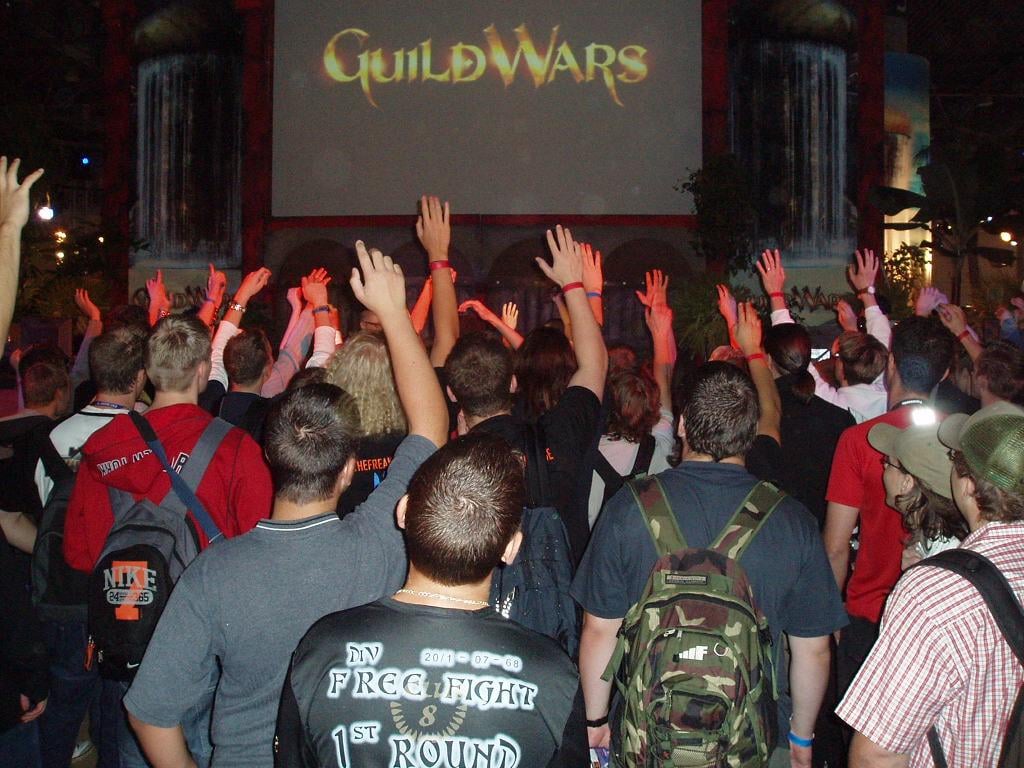
Source: Eero Lahtinen
I wanted to understand what made Guild Wars more than just another game people played for a few months before moving on. There were many other online games released around that time, but only some managed to build a community that treated them almost like a second home.
LKP: At the time, MMORPGs and RTS games dominated the global online gaming scene, but there weren't many truly groundbreaking new titles. Guild Wars, however, distinguished itself with a unique world, a strong narrative foundation, and a fresh CORPG structure. More importantly, its Guild vs. Guild tournament system centered around strategy and combat helped pioneer the early esports scene. Even though it was a game, it constantly challenged me to solve problems, adapt under pressure, and collaborate with others to find solutions.
EL: A bit of both fun and competitiveness. When I played Diablo I also did some PvP, but mostly it was about killing monsters and having fun. I think I expected Guild Wars to be some sort of fun PvP game with more strategy than Diablo. As I'm remembering it now — I think it was the Underworld, or some elite PvE area, where I met a bunch of Finnish guys looking for players. That's how I got into my first guild, which also did Tombs — that was the other PvP area besides Guild versus Guild. Then I had a friend who knew one of the players in real life, and that's how I got into GvGs. Basically a coincidence.
There is a very interesting contrast between these two stories. Eero seems to come from a place of pure empiricism: he tries the game, gets hooked, and somehow finds himself in one of the best guilds in the world. Kyung Pyo, on the other hand, seems to know exactly what he is looking for and what draws him to the game. His observations gravitate more toward preparation and structure. I wanted to know what their organisations looked like behind the scenes. Were there any formal practices?
EL: Nothing at all. It was just kids having fun — and mostly, I think, kids disagreeing and arguing and teasing each other, whatever. A mess in the beginning, no organization at all. Later on, when things progressed, it looked more like a proper guild, but even then there was basically no leadership or formal practice. I remember our first LAN championship — I think we got lucky, because maybe the best team in Europe had a disconnection or some technical problem when they played us. If everything had gone as it should, we probably would have lost.
I think Eero is being a little modest here. According to the official ladder, between October and December 2005 his first team played 223 games and maintained a 71.3% win rate. Either they were genuinely excellent or their opponents disconnected 159 times.
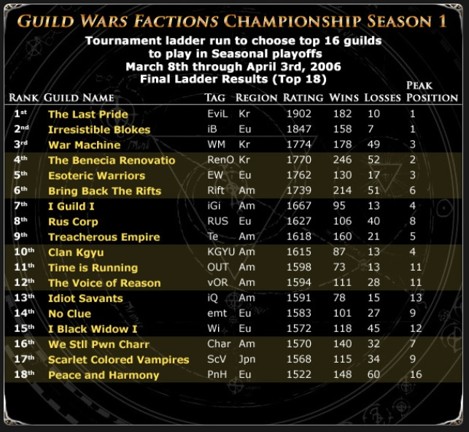
EvIL and iB at the top of the ladder
Source: Lee Kyung Pyo
I asked him when he realised they were actually good — when it stopped being casual.
EL: I think it was after the first championship, when I played in Irresistible Blokes. That's when I knew we were actually good and could probably make it to the next one. But even then it was mostly just us having fun — most of us were teenagers, some already had responsibilities, and it was actually quite hard to get eight people online at the same time. A few guys played a lot, a few played the bare minimum, some were in the middle.
The response from my second interviewee sat at the opposite end of the spectrum. Reading it felt less like a gaming interview and more like being handed the operating manual for a military campaign. He sent pages describing practice structures, tactical development, build testing in secondary guilds, and the level of detail that went into analysing opponents.
LKP: Personally, this was one of the most important confidential aspects of our approach. Identifying the opponent's build was only the baseline — beyond that, we invested significant effort into understanding who was operating that build and how they were executing it.
I read about their three-layered leadership system, which allowed them to adapt dynamically depending on map conditions, team splits, and enemy builds. If practice really makes perfect, this was probably the best example:
LKP: We played at least five days a week. Beyond gameplay, we spent time every day discussing and refining strategies. We practiced before every match, analyzed losses through spectator mode, and regularly scrimmed against selected guilds. Before entering any Guild Battle, EvIL always conducted internal scrimmages. We only proceeded to official matches after thoroughly practicing and confirming each player's skills and assigned roles up until the very last moment.
We didn't just play — we worked. Strategy discussions, testing, feedback, and documentation were constant. Even when we weren't logged in, we were effectively still "playing" Guild Wars. This led to hundreds of prepared set plays and fast decision-making under pressure.
One part stood out to me more than anything else. For a moment, it felt like I was reading something very few people had ever been allowed to see.
LKP: EvIL's offensive approach was highly diverse. While I can't reveal every detail even today, I can share some of the key operational principles behind it...
The principles themselves were highly tactical and, admittedly, far beyond my level of understanding. But the mere fact that there may still be unrevealed secrets behind The Last Pride, nearly twenty years later, feels almost unthinkable.
Both of them competed at the highest level and faced each other both online and at LAN tournaments. I was curious how they viewed one another. What did European players think about South Korean guilds, and vice versa?
EL: The Guild Wars matchmaking, at its peak, was so global, and that made it really fun. We realized the South Korean guys played a lot. What I remember about War Machine or The Last Pride is that they stood out for great individual skill. And they were maybe the first guilds to bring the role-playing side into PvP too — exciting skins and armor. We played with PvP characters only, but they had the role-playing part covered as well. They were really good — maybe not so much on strategy and build theory, but individual macro and mechanics, all that kind of stuff.
LKP: There were many strong competitors. I still remember guilds like EW for their strong team fights, iB for their movement and triple monk builds, iQ's triple warrior composition, and TE's double elementalist builds.
Earlier I mentioned the LAN tournaments. These were not just ordinary events — they were the Guild Wars World Championships, held in Taipei and Leipzig in 2006. I wanted to know what those competitions actually felt like from the inside. What was the atmosphere like? How professional was the whole experience compared to modern esports?
EL: I don't think there was really anything professional about it, but people tried their best. Both venues were general gaming conventions, lots of tech and other games around. Fun stuff happening besides Guild Wars too. But neither was very professional in terms of setup — the first time the hardware was pretty bad, the keyboards and mice. The second time I brought my own gear.
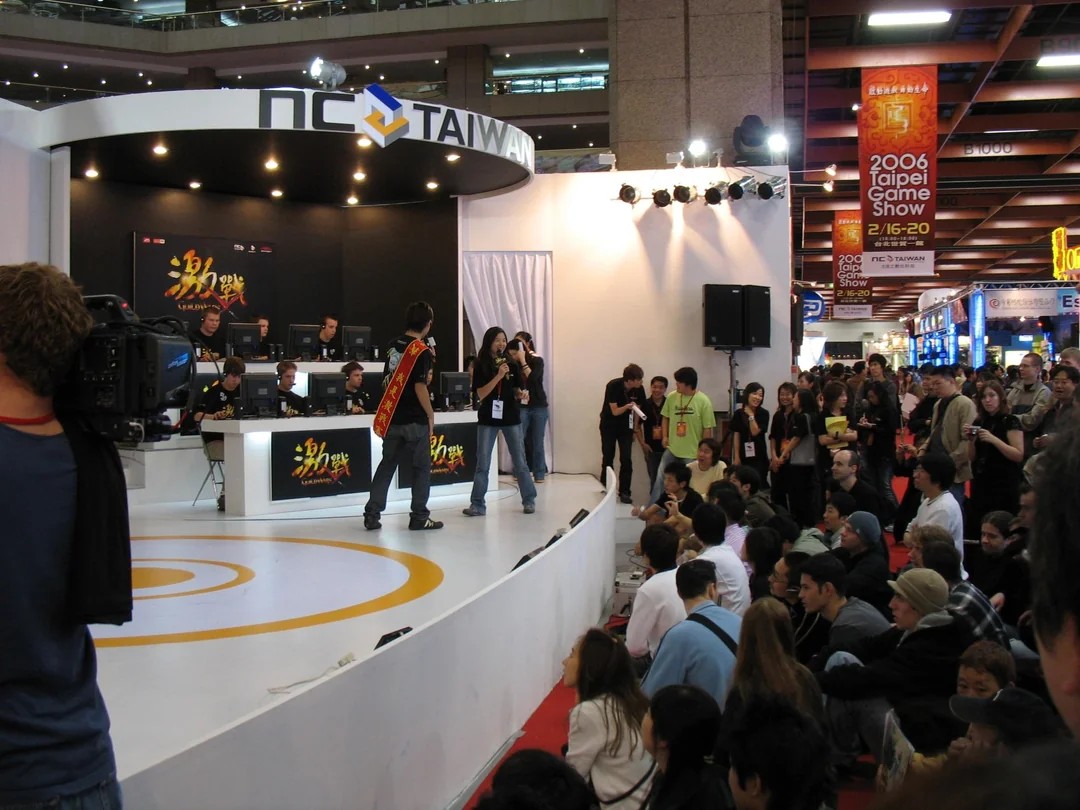
Guild Wars World Championship - Taipei 2006
Source: Eero Lahtinen
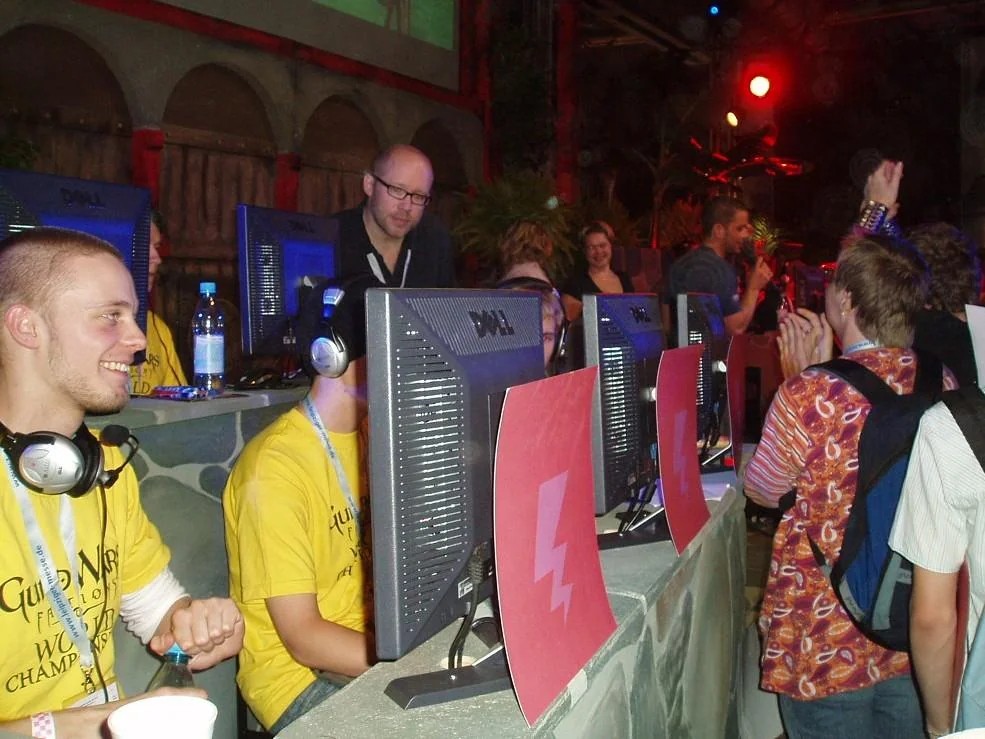
Guild Wars Factions World Championship - Leipzig 2006
Source: Eero Lahtinen
I was also curious whether the prize money created additional pressure.
EL: Maybe the second time. The first time it was such an amazing experience just to be in Taipei — we won our first matches and got some money out of it. The second time we weren't the favourites, but I think all of us knew we actually had a chance to win the whole thing. So it felt different, but I don't think we felt pressure exactly. Mostly you're just playing online from your bedroom, and suddenly you're in the middle of a huge gaming convention with tons of noise and different equipment — totally different environment. Maybe that affected us somehow.
I asked Lee Kyung Pyo the same question. Nearly twenty years later, what stood out most from those international tournaments?
LKP: The excitement on stage is still vivid. There were moments of both great joy and deep disappointment. I still regret not being able to use a special build we prepared for a tournament in Germany — I believe it could have led to back-to-back world championships.
Thanks to NCSoft and ArenaNet, I had the opportunity to attend global events like E3, TGS and Gamescom at a young age. Competing on the world stage, meeting players from different countries, and even connecting with fans at airports are unforgettable memories. Some of those friendships still continue today.
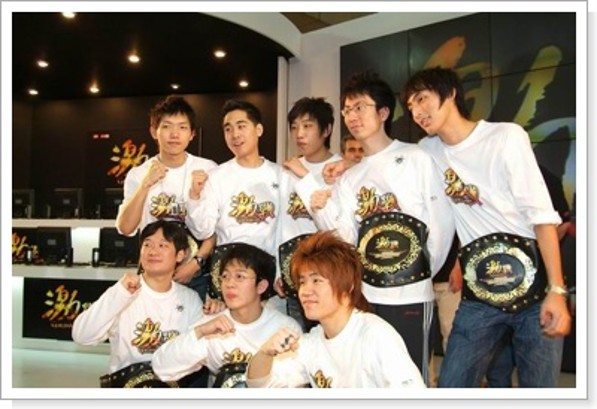
Victorious EvIL — Taipei 2006
Source: Lee Kyung Pyo
Looking at esports today, it is difficult not to compare the two worlds. Modern competitive gaming means sponsorship deals, social media followings, dedicated organisations and arenas packed with people watching Counter-Strike, League of Legends or Mortal Kombat. Compared to that, Guild Wars felt almost intimate. Was esports simply too early to become the industry it is today, or am I underestimating how much money and organisation already existed behind the scenes?
LKP: Esports was still in its early stages. It felt more like representing our country in competition. We mostly self-funded our equipment. After our first championship, we received a one-time sponsorship from Razer.
EL: Not at all. Regarding tournaments ArenaNet paid for the whole thing. I think we paid for the ride to the airport, but the flight, the accommodation, everything else was covered. Five-star hotel, all the dinners, meals, sightseeing included. I don't know how much it cost them, but that's how it was. They used a lot of money to promote the game, I'm sure of that.
By the sound of it, both players have very fond memories of ArenaNet and NCSoft. It made me think that if I were ever sent on a business trip abroad and treated to five-star hotels, sightseeing, and international tournaments, I would probably speak highly of the company too. The closest equivalent in my professional career was once being offered an Uber across London to deliver equipment between two franchise locations. Similar scale, obviously.
Before wrapping up the interview, I wanted to ask both of them about modern gaming and whether they felt something had been lost along the way.
EL: It's a huge, huge question. After Guild Wars I don't think I played anything for about 15 years. Recently I bought a PC and have been doing simulators, some indie games, and of course classics like Guild Wars and Diablo 2. But I'm probably not the best person to answer this. I think the priority now is monetization and profit, rather than fun and great gameplay. Back in the day, with Guild Wars, sure, there was a ranking system and a small chance to make it to the LAN championships, but beyond that, it was really just about having fun and playing a great game. You didn't need fancy titles or skins, and you didn't have to worry about how the game was monetizing you.
LKP: Today, many games lack a clear identity and tend to follow trends. Guild Wars had a distinct and lasting appeal. I hope future titles, including a potential Guild Wars mobile version, can recapture that depth. Currently, League of Legends stands as the most successful title in the esports industry. Compared to Guild Wars in the past, its gameplay is relatively simpler in terms of depth, but it is more entertaining to watch and much easier for spectators to understand. As for many other games today, they seem to focus less on delivering deep gameplay experiences and more on providing quick satisfaction through monetization. I sometimes question whether they can truly be remembered by players for a long time as "real games," in the same way Guild Wars has been.
What struck me was how similar their answers were despite living on opposite sides of the planet. Both pointed to the same thing: modern games often feel designed around retention, engagement, and monetization, while older games felt more interested in simply being good games.
Maybe that's nostalgia talking. Maybe every generation believes its games were better. But I do think the market has become so saturated that it is increasingly difficult for a title to leave a lasting mark. There are simply too many games competing for the same finite amount of time.
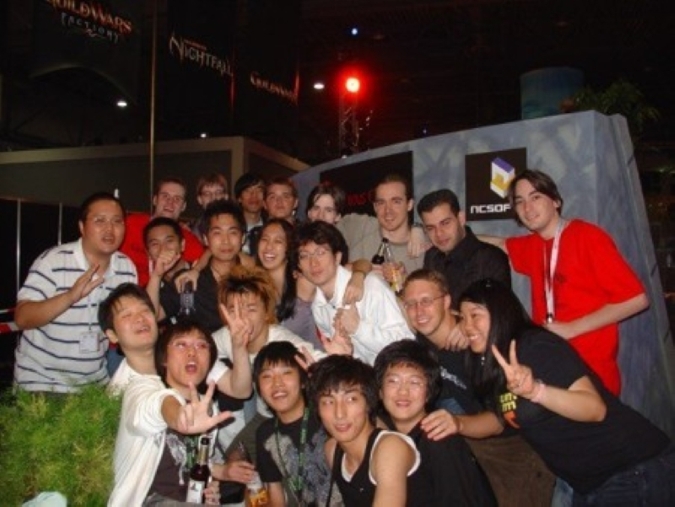
Friendships - E3 Los Angeles 2006
Source: Lee Kyung Pyo
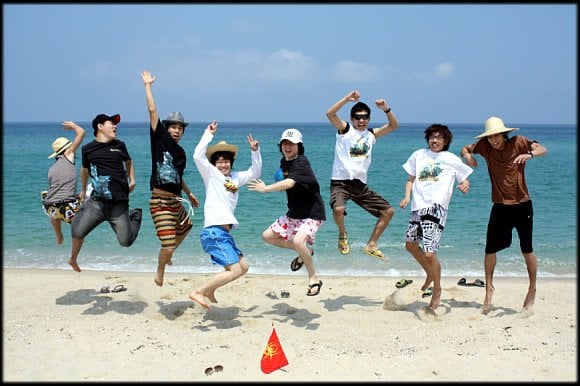
EvIL reunited after military service - 2009
Source: Lee Kyung Pyo
Which brings me back to Guild Wars. What made it special enough that people still talk about it two decades later? I think it was a combination of accessibility, competition, and community. While speaking to Kyung Pyo and Eero, I found myself reconstructing my own memories of the game: the friends I met online, the ranked matches where I desperately tried to keep everyone alive as a Monk, and the spectacularly tacky guild names we came up with. Things like Shadow of Gomorra or Gemini of Victory — fantasy names filtered through the unique lens of teenage Poles whose English was still very much a work in progress.
I remember the excitement of hearing our guild mentioned on a Polish gaming radio show. I remember the occasional miracle match when we somehow managed to defeat one of the strongest Polish guilds on the ladder. More than anything, I remember the people.
The fact that I still remember guild tags, nicknames, and specific matches after nearly twenty years probably tells me everything I need to know. Guild Wars was a community. And if these interviews confirmed anything, it is that this community is very much alive.
EL: I still think the game is amazing. It's nostalgic for me too, sure, but even now, when I play, immersion and fun — that's just it. It was really great. The most fun I've ever played, and of course five hours would go by just like that. Guild Wars is probably the best game I've ever played. So it's always nice to talk about it to someone who actually cares and is interested.
LKP: Guild Wars gave me some of the most meaningful experiences of my life. In my twenties — an age when it's easy to feel lost — it gave me something to be truly passionate about. Even as "just a game," it constantly pushed me to solve problems, adapt under pressure, and work with others to find solutions. It connected me with players from all over the world and broadened my perspective through the travel that came with it. And winning tournaments, being picked as a national representative, becoming a world champion — that gave me real pride, knowing I'd contributed to esports history.
It also changed how I see societal expectations. There was a strong bias against gaming back then, but choosing Guild Wars and dedicating my twenties to it turned out to be one of the best decisions I ever made. Over time, I realized a lot of people hold themselves back from their own path just because of what others think.