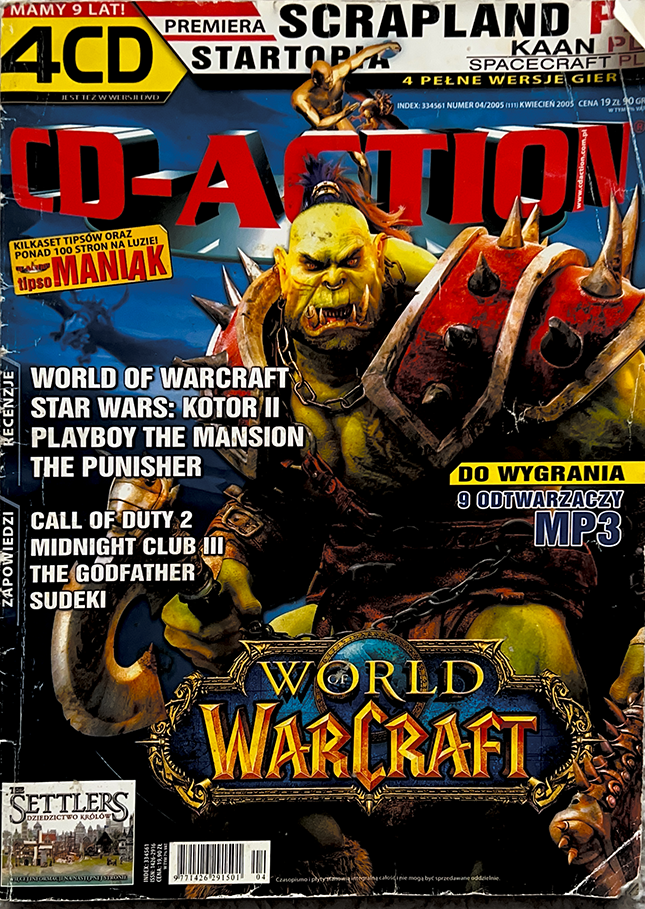
CD-Action issue 04/2005 cover
If you ever had the chance to get your hands on tech or gaming magazines from the era when those topics still felt sci-fun rather than part of everyday life, you probably remember the tone. A little naïve. A little overexcited. Occasionally very cheesy.
Today I want to pay tribute to one of those texts: a World of Warcraft review from the Polish gaming magazine CD-ACTION, issue 04/2005, written by a persona known as GEM.
The review opens like this:
Year 621 after the opening of the Dark Portal.
I, Yordi of Ironforge, a humble servant of the Holy Light, begin writing the chronicle of my deeds…
The reason for doing so is that… the world has gone mad.
No, not like that — there is actually nothing unusual about that.
It is because the world has gone mad about the World of Warcraft.
And there it is — the cheese. Simplicity, poor dualism, and "cool" immersion right from the first lines.
But there’s also something genuinely charming here. This kind of writing came from a time when editorial offices were mostly just groups of like-minded people: similar interests, similar fashion sense, playing games obsessively and writing about them because they wanted to. Not because of SEO, engagement metrics, or monetization strategies.
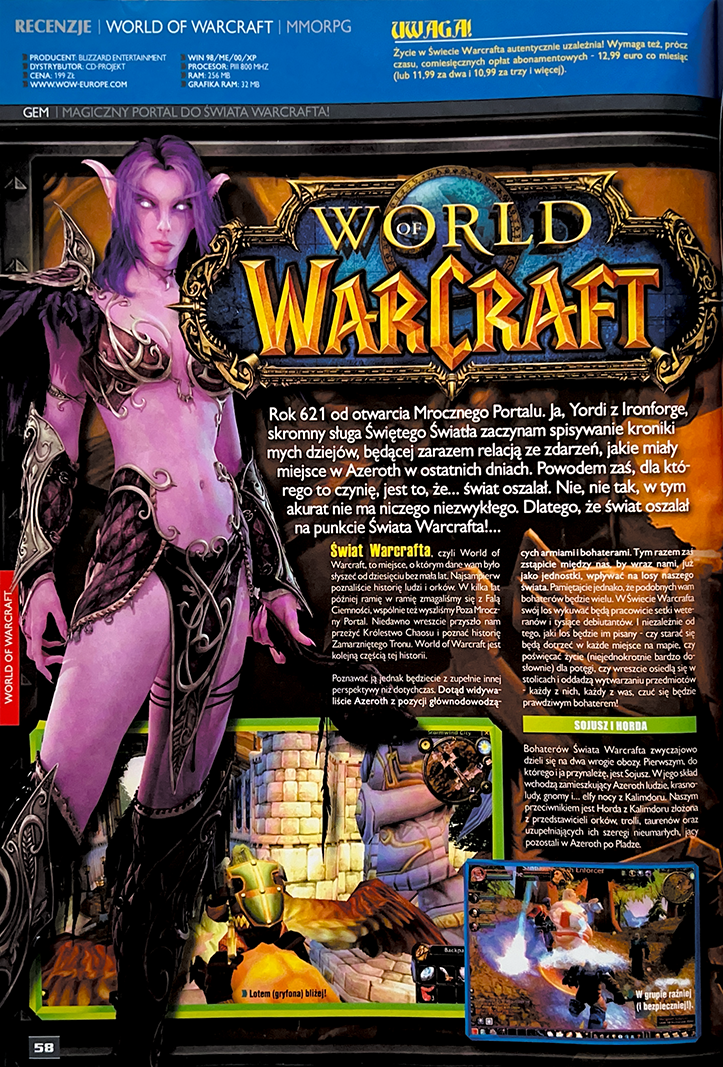
First page of the original review
Interestingly, the entire text barely scratches the surface of World of Warcraft as a system. GEM — or perhaps Yordi, depending on how seriously we take the role-play — touches on the basics: races, classes, professions, character creation, and a short overview of the lore.
He never really dives into mechanics that would later become essential to the genre — raiding, talent trees, PvP versus PvE, or even questing. There is no real reason to explain these systems here. Anyone who remembers them doesn’t need the reminder, and anyone who doesn’t is unlikely to care. Either way, it would miss the point:
There are as many as nine classes, and not all are available to every race.
There is no single class among them that is clearly weaker than the others.
Each class has its extraordinary abilities…
That’s about as deep as it goes.
The whole review reads like an ecstatic monologue from a classmate who just saw an amazing movie. You’re not entirely sure what they’re talking about, but you definitely feel the need to respect the enthusiasm.
Would this convince me to buy the game today? Probably not. Would it have worked in 2005? Most likely.
GEM doesn’t hide his excitement, and the review feels rushed in the best possible way — as if he’s writing against the clock because he wants nothing more than to get back into the game:
Even now, as I sit at the table and write down my impressions, I struggle with the desire to throw down the quill, don chainmail, take up axe and shield, and once again set out into the unknown.
That line says more than any feature list ever could.
GEM wasn’t really reviewing a video game. He was writing about a social phenomenon — about the roots of what would later be labeled the MMORPG genre.
I’m not entirely sure something like this had happened in the gaming industry before. Of course, there had already been titles like The Sims, EverQuest, or Counter-Strike, but nothing on this scale — and nothing that offered so many ways to inhabit a character and shape an identity within a shared world. I’m willing to risk the opinion that this was one of the purest gaming experiences of its time.
There was no single, linear questline and no clearly defined way to “finish” the game. Enjoyment wasn’t prescribed; it emerged organically from how players chose to exist in the world. This is something the original review captures surprisingly well:
In World of Warcraft, hundreds of veterans and thousands of debutants will diligently forge their fates. Regardless of what fate awaits them — whether they attempt to reach every place on the map, whether they sacrifice their lives (often very literally) for power, or finally settle in the capitals and devote themselves to crafting items — each of them, each of you, will feel like a true hero.
Online games and MMOs existed long before World of Warcraft, of course. But twenty years later, only one of them endured long enough to become an entire franchise — a cultural reference point and a record-breaking machine. Festivals, mainstream television nods like The Big Bang Theory, a feature film released in 2016, and even a now-famous South Park episode.
In 2005, the CD-ACTION team couldn’t possibly have known that the game they were clearly getting addicted to for the purpose of reviewing it would still be standing strong in 2026. And yet, reading this review today, it feels almost inevitable.
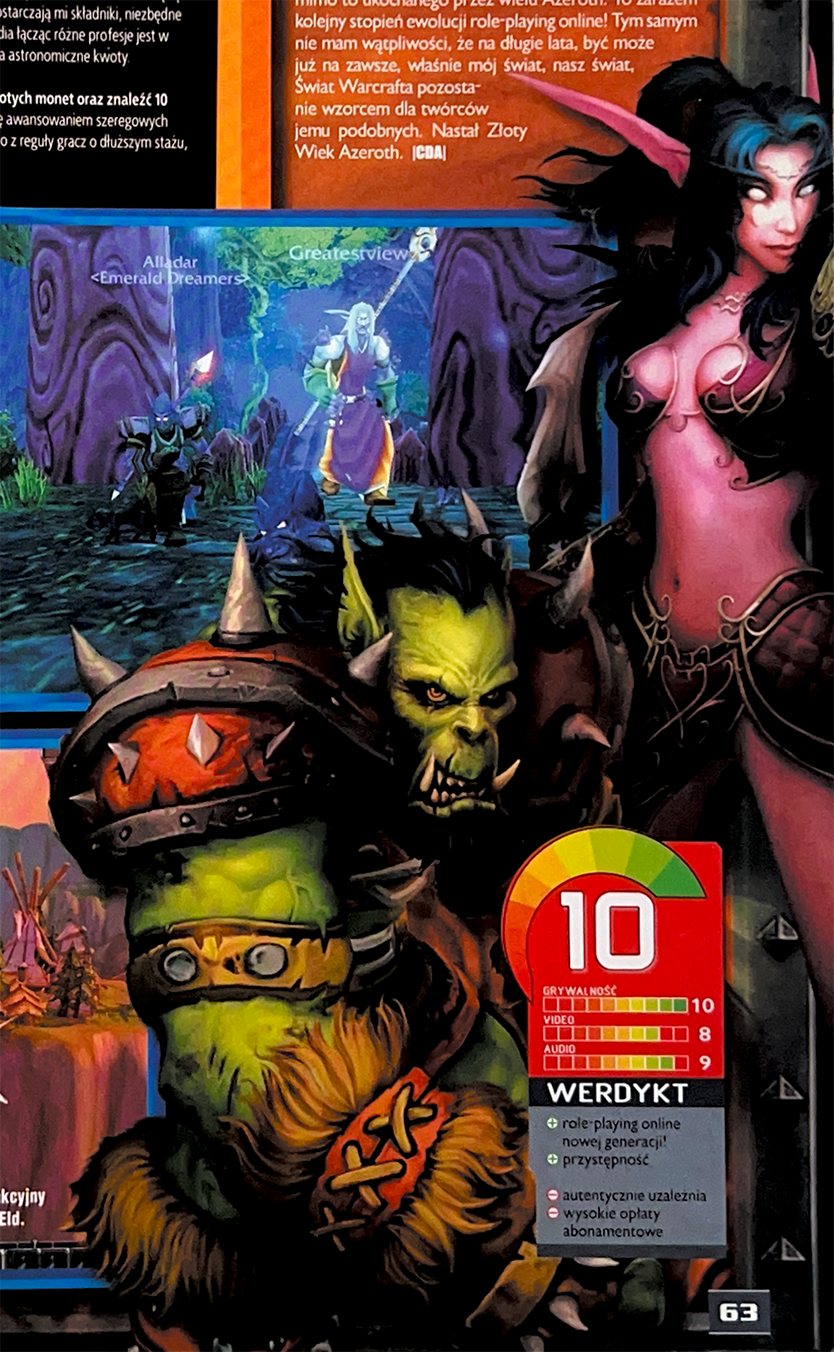
Unsurprisingly, World of Warcraft received a 10/10, with a note that it was truly addictive.
I think it’s fair to say they were right.
Curated for Lost Net
Source: CD-ACTION Magazine, Issue 04/2005